


Page 43 - Year 8 Spring 2026 Knowledge Organiser
P. 43
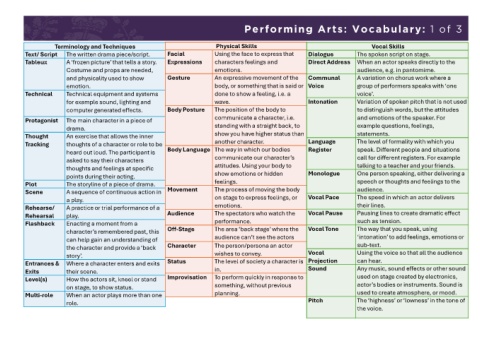
Performing Arts: Vocabulary: 1 of 3


                    Terminology and Techniques                               Physical Skills                                       Vocal Skills
          Text/ Script  The written drama piece/script.     Facial          Using the face to express that   Dialogue         The spoken script on stage.
          Tableux       A ‘frozen picture’ that tells a story.   Expressions  characters feelings and        Direct Address   When an actor speaks directly to the
                        Costume and props are needed,                       emotions.                                         audience, e.g. in pantomime.
                        and physicality used to show        Gesture         An expressive movement of the    Communal         A variation on chorus work where a
                        emotion.                                            body, or something that is said or  Voice         group of performers speaks with ‘one
          Technical     Technical equipment and systems                     done to show a feeling, i.e. a                    voice’.
                        for example sound, lighting and                     wave.                            Intonation       Variation of spoken pitch that is not used
                        computer generated effects.         Body Posture    The position of the body to                       to distinguish words, but the attitudes

          Protagonist   The main character in a piece of                    communicate a character, i.e.                     and emotions of the speaker. For
                        drama.                                              standing with a straight back, to                 example questions, feelings,
          Thought       An exercise that allows the inner                   show you have higher status than                  statements.
          Tracking      thoughts of a character or role to be               another character.               Language         The level of formality with which you
                        heard out loud. The participant is   Body Language  The way in which our bodies      Register         speak. Different people and situations
                        asked to say their characters                       communicate our character’s                       call for different registers. For example
                        thoughts and feelings at specific                   attitudes. Using your body to                     talking to a teacher and your friends.
                        points during their acting.                         show emotions or hidden          Monologue        One person speaking, either delivering a
          Plot          The storyline of a piece of drama.                  feelings.                                         speech or thoughts and feelings to the
          Scene         A sequence of continuous action in   Movement       The process of moving the body                    audience.
                        a play.                                             on stage to express feelings, or   Vocal Pace     The speed in which an actor delivers
          Rehearse/     A practice or trial performance of a                emotions.                                         their lines.
          Rehearsal     play.                               Audience        The spectators who watch the     Vocal Pause      Pausing lines to create dramatic effect
          Flashback     Enacting a moment from a                            performance.                                      such as tension.
                        character’s remembered past, this   Off-Stage       The area ‘back stage’ where the   Vocal Tone      The way that you speak, using
                        can help gain an understanding of                   audience can’t see the actors                     ‘intonation’ to add feelings, emotions or
                        the character and provide a ‘back   Character       The person/persona an actor                       sub-text.
                        story’.                                             wishes to convey.                Vocal            Using the voice so that all the audience
          Entrances &  Where a character enters and exits   Status          The level of society a character is  Projection   can hear.
          Exits         their scene.                                        in.                              Sound            Any music, sound effects or other sound
          Level(s)      How the actors sit, kneel or stand   Improvisation  To perform quickly in response to                 used on stage created by electronics,
                        on stage, to show status.                           something, without previous                       actor’s bodies or instruments. Sound is
          Multi-role    When an actor plays more than one                   planning.                                         used to create atmosphere, or mood.
                        role.                                                                                Pitch            The ‘highness’ or ‘lowness’ in the tone of
                                                                                                                              the voice.

