


Page 44 - Year 8 Spring 2026 Knowledge Organiser
P. 44
Performing Arts: Drama Focus: Alice in Wonderland: 2 of 3


                                                                                       Key Term          Definition

                                                                                                         Movement performed much more slowly than
                                                                                       Slow Motion normal to highlight an action or create
                                                                                                         dramatic effect.
                                                                                                         A frozen moment on stage where actors stay
                                                                                       Still Image       completely still to show an important idea,

                                                                                                         relationship or moment.

                                                                                                         Using different heights (high, medium, low) on
                                                                                       Levels
       There are five key elements to every story:                                                       stage to show status, power, focus or interest.


       1.     Plot – the events or actions that drive the story.                       Body              How an actor uses their body to
                                                                                                         communicate feelings, relationships or
       2.     Setting – the physical location and point in time in which the           Language          attitudes without speaking.
              story takes place.
                                                                                       Facial            How an actor uses their face to show
       3.     Characters – the people, animals, beings or objects driving              Expressions emotions and reactions.
              the story.                                                                                 Movements of the hands, arms or head that
                                                                                       Gestures
       4.     Point of view – the lens through which the story is being told                             communicate meaning or emotion.
              (e.g., first person, third person).                                                        How close or far actors are from each other

       5.     Conflict – what is the main character trying to overcome?                Proximity         on stage, used to show relationships, tension
                                                                                                         or status.


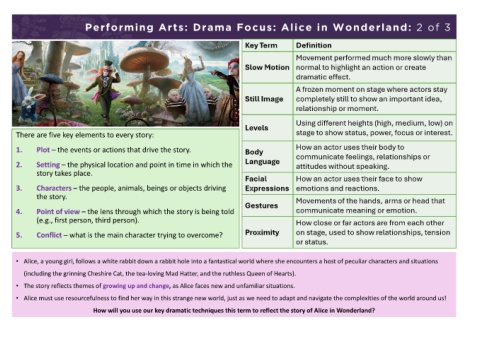
       • Alice, a young girl, follows a white rabbit down a rabbit hole into a fantastical world where she encounters a host of peculiar characters and situations

         (including the grinning Cheshire Cat, the tea-loving Mad Hatter, and the ruthless Queen of Hearts).

       • The story reflects themes of growing up and change, as Alice faces new and unfamiliar situations.
       • Alice must use resourcefulness to find her way in this strange new world, just as we need to adapt and navigate the complexities of the world around us!

                                  How will you use our key dramatic techniques this term to reflect the story of Alice in Wonderland?

