


Page 54 - Year 8 Spring 2026 Knowledge Organiser
P. 54
PE: Orienteering: 7 of 9


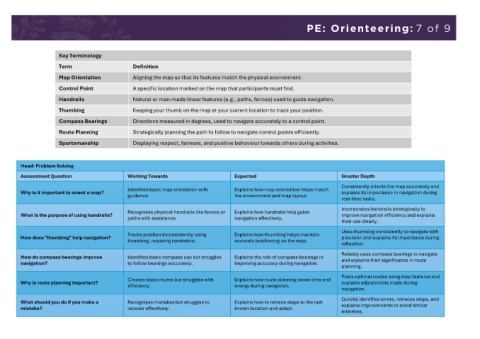
                      Key Terminology

                      Term                      Definition
                      Map Orientation           Aligning the map so that its features match the physical environment.
                      Control Point             A specific location marked on the map that participants must find.

                      Handrails                 Natural or man-made linear features (e.g., paths, fences) used to guide navigation.
                      Thumbing                  Keeping your thumb on the map at your current location to track your position.

                      Compass Bearings          Directions measured in degrees, used to navigate accurately to a control point.
                      Route Planning            Strategically planning the path to follow to navigate control points efficiently.
                      Sportsmanship             Displaying respect, fairness, and positive behaviour towards others during activities.


        Head: Problem Solving
        Assessment Question                   Working Towards                      Expected                              Greater Depth
                                                                                                                         Consistently orients the map accurately and
                                              Identifies basic map orientation with   Explains how map orientation helps match
        Why is it important to orient a map?                                                                             explains its importance in navigation during
                                              guidance.                            the environment and map layout.
                                                                                                                         real-time tasks.
                                                                                                                         Incorporates handrails strategically to
                                              Recognises physical handrails like fences or   Explains how handrails help guide
        What is the purpose of using handrails?                                                                          improve navigation efficiency and explains
                                              paths with assistance.               navigation effectively.
                                                                                                                         their use clearly.
                                                                                                                         Uses thumbing consistently to navigate with
                                              Tracks position inconsistently using   Explains how thumbing helps maintain
        How does "thumbing" help navigation?                                                                             precision and explains its importance during
                                              thumbing, requiring reminders.       accurate positioning on the map.
                                                                                                                         reflection.
                                                                                                                         Reliably uses compass bearings to navigate
        How do compass bearings improve       Identifies basic compass use but struggles   Explains the role of compass bearings in
        navigation?                           to follow bearings accurately.       improving accuracy during navigation.  and explains their significance in route
                                                                                                                         planning.
                                                                                                                         Plans optimal routes using map features and
                                              Creates basic routes but struggles with   Explains how route planning saves time and
        Why is route planning important?                                                                                 explains adjustments made during
                                              efficiency.                          energy during navigation.
                                                                                                                         navigation.
                                                                                                                         Quickly identifies errors, retraces steps, and
        What should you do if you make a      Recognises mistakes but struggles to   Explains how to retrace steps to the last   explains improvements to avoid similar
        mistake?                              recover effectively.                 known location and adapt.
                                                                                                                         mistakes.

